NEXT FSI EUROPE EVENT 30/11: The EU’s Deep State – Who really rules Brussels?
Join us for our next event and the release of our first report by Thomas Fazi, Senior Research Fellow, FSI Europe.
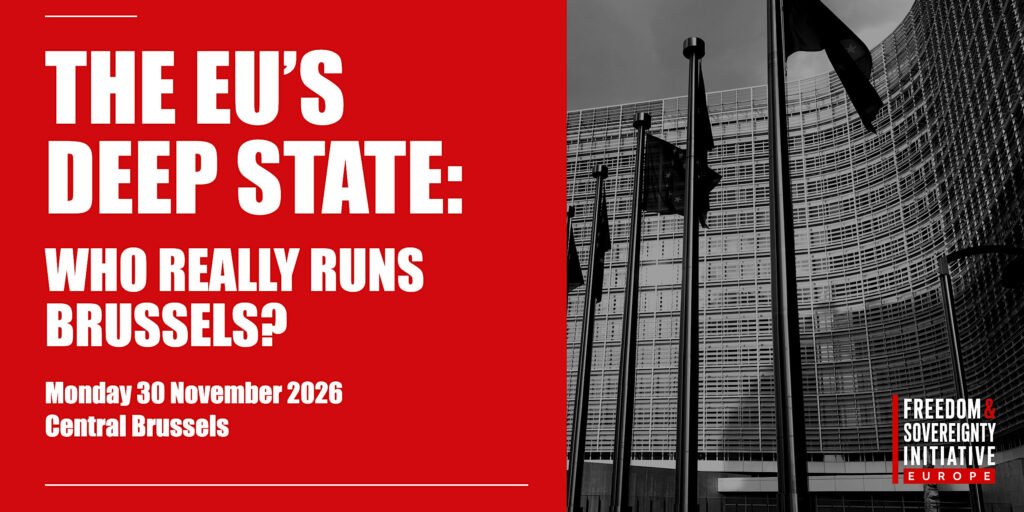
The EU’s Deep State: Who really rules Brussels?
30 November 2026 · 6.30 – 8:00 pm (followed by a wine reception)
Venue: Central Brussels TBA
Registration from 6:00 pm
Speakers include:
- Thomas Fazi – Senior Research Fellow, FSI Europe, and author of ‘The EU’s Deep State’
- Barbara Bonte – MEP, Vlaams Belang, Patriots for Europe Group (PfE)
- Richard Schenk – Research Director, FSI Europe
REGISTER HERE:
https://www.eventbrite.com/e/the-eus-deep-state-who-really-rules-brussels-tickets-200473588098
The European Union is supposed to be a democracy. It has an elected Parliament, and a Commission which changes based on the political reality of those elections. But how much can European citizens really change? If Europeans elected politicians opposed to the technocratic mainstream of the European Union, would they really be able to implement their agenda? A new report lifts the lid on the permanent bureaucracy at the heart of the European Union and argues that very little change is possible, by design.
Freedom and Sovereignty Initiative Europe (FSI Europe) is launching ‘The EU’s Deep State’, a major new report by Thomas Fazi that uncovers this system and explains how it works. For the first time, it names the officials at the heart of the European Union, traces their careers and shows that a permanent bureacratic governing class stands between 450 million Europeans and the international organisation that controls much of their daily lives.
This is not a conspiracy theory. There is no cabal, no secret plan and no hidden hand. Nobody has to plot against an elected majority, because the institutions do the work on their own. The EU’s deep state is a product of the Union’s own institutional design. It hides in plain sight, behind the system’s complexity, the technical language of regulation, and the obscurity of the officials who run it.
The report also counts the cost. In 2025, the EU’s official administrative spending came to €12.8 billion. That figure leaves out some €4.7 billion in agency budgets, as well as the ‘special instruments’ the Commission draws on when the ordinary budget runs short.
This is why the familiar remedies fail. Giving the Parliament more powers or electing the Commission President directly both assume the system is sound and needs only adjusting. The report argues that the permanent bureaucracy is the form supranational government must take, and that no election anywhere in the EU can remove it.
So what is the patriotic movement fighting for? Can it win power in Brussels and use it, or does the machine outlast every attempt to reform it? And what kind of European cooperation should replace it?
Join author Thomas Fazi, Barbara Bonte MEP, and Richard Schenk for the launch of ‘The EU’s Deep State’ and a serious argument about who governs Europe.